
Picture this. Architecture review. You’re the Head of Engineering, you join for the last twenty minutes, and you casually throw out a thought: “Just thinking out loud… what if we moved this to event-driven?”
Nobody disagrees. Two weeks later, the team is rebuilding half the service. When you ask why, someone says, a bit confused: “But… you said so.”
You didn’t say so. You were thinking out loud. But your title was in the room before you were, and it turned a question into a decision.
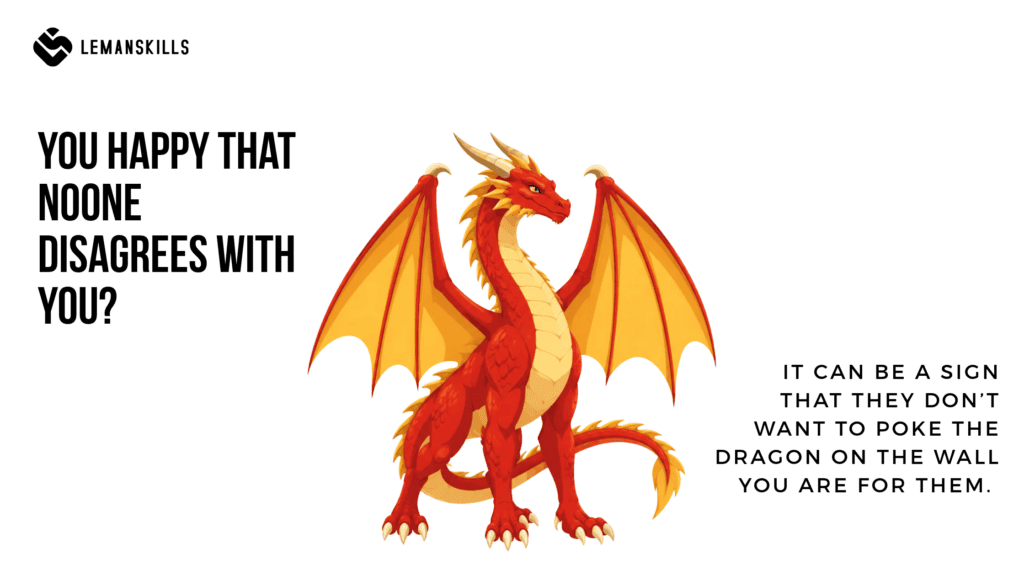
In episode #184 of the podcast, Keith Zubchevich (CEO of Conviva, 35 years in tech) shared the sentence his Co-Founder Wei used to tell him: “Keith, you’re not a fly on the wall. You’re a dragon on the wall.” I haven’t stopped thinking about it since. Because almost every tech leader I mentor believes they are the fly.
Silence Is Not Alignment
If your team never pushes back, it doesn’t mean you’re always right. It usually means it’s too expensive to tell you that you’re wrong.
The research is pretty clear here. In a study by Milliken, Morrison and Hewlin, 85% of respondents said they had stayed silent about an issue they considered important rather than raise it with their supervisor. The most common reason? Fear of being labeled negatively and damaging valued relationships. Not fear of being fired. Fear of being seen as “difficult”.
And here’s the part that should worry you most. Detert and Burris found that leaders’ openness has the strongest impact on the voice of their best-performing employees. The people with the most valuable ideas are exactly the ones reading your signals most carefully.
In their Harvard Business Review article, the same researchers show that many “open door” tactics backfire. Anonymous surveys, for example, can quietly send the message that speaking openly isn’t safe. Their advice: tone down the power cues and go ask people directly.
Your open door is not open just because you say so.
Vulnerability Doesn’t Come After Trust. It Comes Before.
Keith starts every annual leadership offsite with two questions. Not “what was your biggest win?” but:
- What are you not good at?
- What is your biggest insecurity?
And he goes first. His answer isn’t a humblebrag about perfectionism. It’s: “Every day I wake up thinking I’m not a great CEO.” He said it was awkward at the beginning. Of course it was. But by the end of the round, the team felt bonded in a way no team-building event ever delivered.
Daniel Coyle calls this the vulnerability loop in The Culture Code: one person signals vulnerability, the other detects it and responds with their own, and trust grows from the exchange. Most of us believe it works the other way around. First trust, then openness. It doesn’t.
I get why it’s hard. Here in Poland, many of us were raised on “be strong, be self-sufficient, never show weakness”. I’m still unlearning it myself. But as Keith put it, you can’t solve a problem you don’t see. And your team can’t complement weaknesses you keep hiding.
How to Take the Title Off (Practically)
- Name the mode before the meeting starts. Keith walks in and says: “In this meeting, I’m just Keith. If I say something stupid, tell me.” And when a decision is already made, he says that too. This is contracting in its simplest form: making the rules explicit, so nobody has to guess whether your idea is a suggestion or an order. It sounds obvious to you. It’s not obvious to them.
- Go first, and go deeper than icing. If you ask for weaknesses and give a “sweet” one, you’ll get sweet ones back. Keep the level human, not personal: what you struggle with at work, not your private trauma. (As Keith joked, you don’t want five seconds of silence after you share and a group therapy session nobody signed up for.)
- Appoint your truth-tellers. Keith has two people with an explicit contract: if I miss something, tell me, no consequences. Choose two people this week. Say it out loud. Then, and this is the hard part, prove it the first time they use it.
- Celebrate the first “no”. When Keith’s new Head of Product told him, “We’re not changing that name,” the room went quiet. His answer: “I love it. No problem.” That one reaction decided whether anyone would ever disagree with him again. How you react to the first disagreement is your real psychological safety policy.
- Speak last when you want real input. Your opinion, spoken first, becomes the anchor. Let the team argue before you add your view, and you’ll hear what they actually think.
And when someone convinces you, change your mind visibly. I wrote a whole piece on how to change your mind in front of your tech team, because nothing builds debate culture faster than a leader saying, “You’re right, I was wrong.”
Why This Matters More in Tech
Your engineers are often closer to the code, the customer and the risk than you are. Your mistakes, as the person at the top, cost more than anyone else’s. One unchallenged “what if” can burn a quarter of engineering capacity. Silence isn’t polite here. It’s expensive.
There’s a personal cost, too. Leaders surrounded by agreement end up surrounded by loneliness. If that already sounds familiar, read Nobody Warned You That Leadership Would Feel This Quiet.
This is what I mean by Communication Intelligence in the CQ Leadership Method: understanding not only what you say, but what your role says for you, before you even open your mouth.
The Bottom Line
Your title is not a personality. It’s a job, and it comes with gravity whether you want it or not. Great leaders don’t pretend the gravity isn’t there. They name it, and then they deliberately switch it off when the team needs to think.
So, here’s my question for you: when was the last time someone on your team told you, out loud and in a meeting, that your idea was wrong?
If you can’t remember, you don’t have alignment. You have a dragon on the wall.
Want the full conversation with Keith? Listen to episode #184 of the Leman Tech Leadership Podcast, and if you missed the first part of the story, read How to Filter Noise Without Missing What Matters. For tools like this every week, join the free Leadership Pulse. And if you want the whole toolbox in one place, grab my book From Code to People.
Until next time, lead without burnout.