

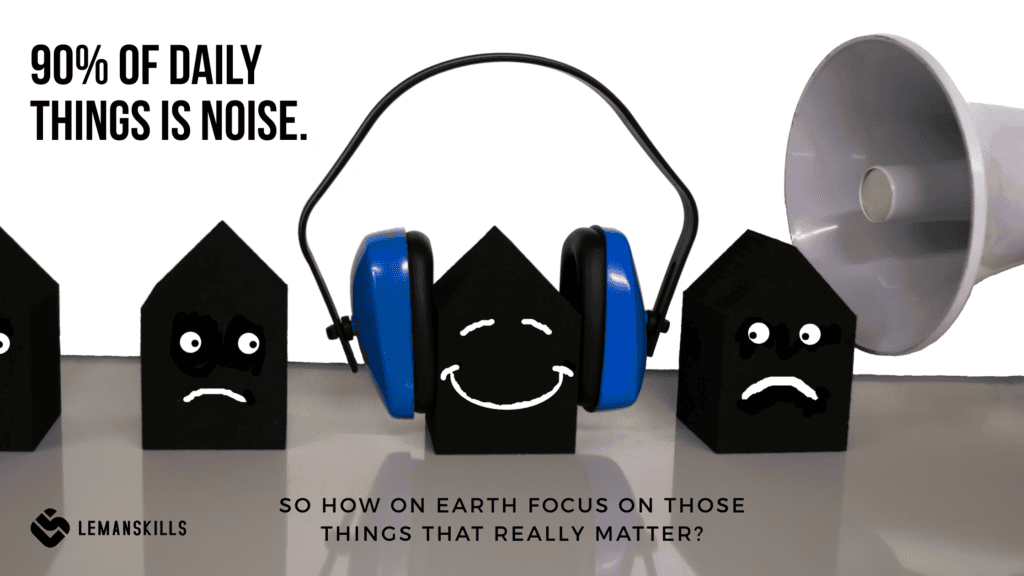
This article is the companion piece to Episode 184 of the Leman Tech Leadership Podcast and this week’s Leadership Pulse on signal vs noise. If you read that one already, you know the premise Keith Zubchevich, CEO of Conviva, gave us: 90% of what lands on your desk daily is noise. Only 10% is signal. If you missed it, no worries; this article stands on its own.
I want to take that premise one step further, because “trust your judgment on what’s signal” is good advice, but it’s not a system. And Tech Leaders don’t need more good advice sitting in a notes app somewhere. You need something you can actually run on a Monday morning, before your calendar already has four meetings stacked before lunch.
So today, let’s build you a real, practical Signal Report. One you can start using this week.
You Don’t Have a Time Problem. You Have a Filter Problem.
Let’s start here, because I see this mistake constantly in my mentoring sessions. Leaders come to me convinced they need better time management. A better calendar tool. One more productivity hack.
But when we dig in (and we always dig in), the real issue isn’t time. It’s that everything arrives at the same priority level. A Slack ping about a typo, a message from your CEO about a strategic pivot, a recurring status meeting nobody remembers the purpose of anymore… they all land in your brain with the same visual weight. Same font. Same little red notification dot.
Your brain was never built to sort that on its own. So it doesn’t. It just reacts, in the order things arrive, not in the order they actually matter.
And here’s what that costs you, in real numbers, not vibes.
Researcher Gloria Mark at UC Irvine has spent over two decades tracking what happens to our attention under constant interruption. Her finding: it takes, on average, 23 minutes to fully regain focus after a single interruption (University of California, 2023). Not 23 seconds. Twenty-three minutes.
Now put that next to what Microsoft found analyzing trillions of Microsoft 365 signals for its 2025 Work Trend Index: knowledge workers are interrupted roughly every two minutes during core work hours, about 275 times a day (Microsoft WorkLab, 2025).
Do that math with me for a second. A single interruption costs 23 minutes of refocus, and you’re interrupted 275 times a day. Obviously that’s not literally happening (you’d need a hundred-hour day). What’s actually happening is quieter and worse: your brain gives up trying to fully refocus at all. It settles into a permanent, shallow, half-attentive state. Always on. Never all the way in.
That’s the “noise” Keith was talking about last week. It’s not just annoying. It is measurably eating your best thinking, every day, in a way you can’t feel happening in real time. You only feel the result: exhaustion by 4pm, and a nagging sense that you worked all day and produced nothing you’re proud of.
Why “Trust Your Judgment” Isn’t Enough on Its Own
Keith’s advice, trust your own read on signal vs noise, is a great starting point. But here’s the piece I want to add, from years of using the CQ Leadership Method with tech leaders: what counts as signal isn’t universal. It depends heavily on how your brain is wired to filter information in the first place, meaning your PCM Base.
Base Thinker filters for data and structure. Noise, for them, is anything vague, an unscheduled “quick sync” with no agenda. Give a Base Thinker clear structure, and they can filter almost anything on their own.
Base Harmonizer filters for relationships. Noise, for them, is unresolved tension, the unspoken “how does this person actually feel about it.” They can drown in the emotional undertone of a Slack thread even when the content itself is simple.
Base Persister filters for values and correctness. Noise is anything that feels sloppy, rushed, or off-principle, even when it’s objectively minor.
Base Promoter filters for opportunity and action. They can get pulled toward literally any shiny, urgent-feeling thing that shows up in front of them.
Base Rebel filters by energy. If something is repetitive or boring, their brain happily lets it become noise, even when it’s genuinely important.
None of this is a flaw. It’s the algorithm you already run. But if you don’t know your own filter, you can’t build a system around it, you just keep white-knuckling your way through the day using willpower where you could be using structure. (I break down all six PCM types on the blog, if you want to identify yours.)
Build Your Own Signal Report
Here’s the framework. It’s simple on purpose. Complicated systems die within a week, I’ve watched it happen to some of the smartest leaders I know.
1. Name your signal once a day, before you open anything. Before Slack, before email, before the first meeting: one sentence. “Today, the signal is ___.” Not five priorities. One. If you can’t name it in a single sentence, you haven’t decided yet; you’re still guessing.
2. Contract with your team about what actually needs you in real time. Most of the noise you drown in exists because nobody ever defined what’s urgent versus what can wait. This is a contracting conversation, not a Slack status update. Sit with your team and agree explicitly on what earns an interruption and what goes into async, batched review. Most teams have never had this conversation out loud. That silence is exactly what floods your day with false urgency.
3. Batch, don’t drip. Check Slack, email, and dashboards at set windows, not continuously. Every “just in case” check costs you that 23-minute refocus tax, whether or not anything important was actually there.
4. Practice saying no to noise, out loud. Not everything that reaches you deserves an answer from you. If this is hard for you, I wrote a full framework for it in Saying No Is a Leadership Skill. A boundaried, respectful no protects your signal capacity better than any productivity app ever will.
5. Build in real quiet time, especially when you feel overwhelmed. This is the piece Keith does that most leaders skip. When it gets loud, he goes for a walk or sits in a park before touching anything else. Not to disappear from the work, but to let his brain finish processing what it already took in, so the next decision comes from clarity, not reactivity. Give yourself that, deliberately, especially on your worst days.
The Bottom Line
You are not failing because you can’t keep up with everything. Nobody can. Ninety percent noise isn’t a personal failing; it’s the current reality of tech leadership. What separates the leaders who burn out from the ones who don’t isn’t less noise coming in. It’s a system for what actually gets through. (If you’re already deep in the burnout zone, start here instead, and come back to this once you’ve got some room to breathe.)
Build your Signal Report this week. One sentence a day. One honest contract with your team about what earns your attention. One boundary you finally say out loud instead of silently resenting.
So here’s my question for you: if you looked back at your calendar and your Slack history from this past week, how much of what you responded to was actually signal? And how much was noise you let in simply because it showed up first?
PS. Did you already get your “From Code to People” copy? If not, now’s the best time to do it!