

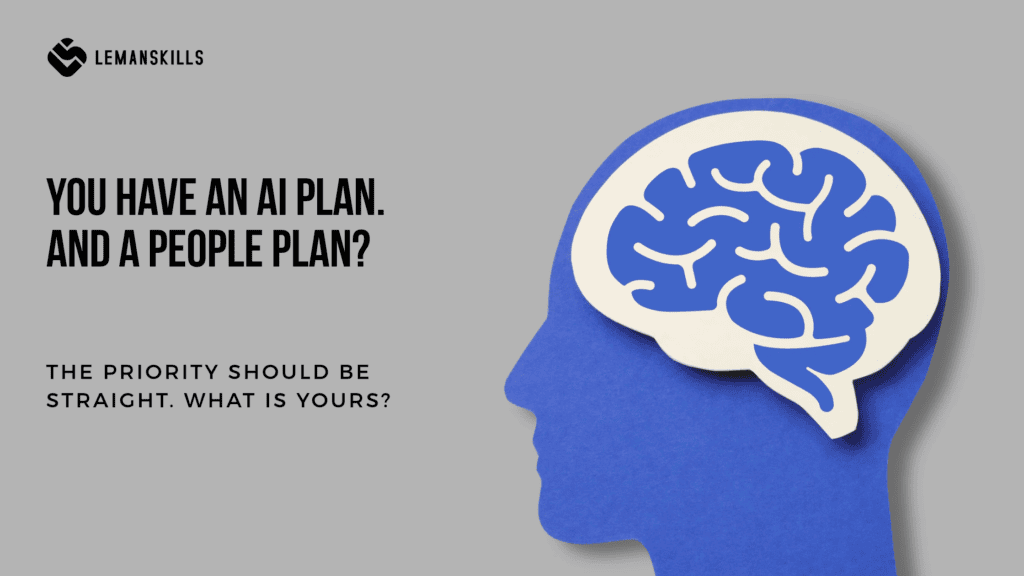
Ask a tech leader about their AI roadmap, and you’ll get fifteen minutes. Tools, pilots, integrations, the agent they want to test next quarter. Clear, confident, with dates. Or maybe not SO perfect, but it is something.
Now ask the same leader about their people development plan. Silence. And then: “Well, the manager program was supposed to start this year, but…”
I see this in organizations of very different sizes and sectors. In this week’s episode of the podcast, I said it out loud: a lot of companies right now overvalue AI and undervalue their people. This article is the practical follow-up.
And let me be clear from the start: I’m not anti-AI. I use it every single day. The problem isn’t the tool. The problem is the imbalance in where the budget, the attention and the genuine curiosity are going.
The Easy Investment Always Wins (By Default)
Here’s the pattern. A new AI tool gets adopted with real energy: a rollout plan, training sessions, leadership attention. Meanwhile, the manager development program quietly slips. Again.
Nobody actually decides that. Nobody stands up and says “people development matters less.” It just happens, because investing in a tool is easier than investing in a person. A tool comes with a price tag, a timeline and a demo. Developing people is slower, messier and harder to measure (not impossible, just harder). So under time pressure, the easier investment wins. Over and over again.
And the result shows up downstream: teams with excellent tools and underdeveloped leaders. Fast systems run by people who were never taught how to lead them well. High performance on paper, high attrition underneath.
What the Research Actually Says
Here’s the irony. The data says that the AI investment itself depends on the people investment.
- BCG describes a 10-20-70 approach to getting value from AI: around 10% of the effort goes to algorithms, 20% to tech and data, and 70% to people and processes. Many budgets I see look closer to the reverse.
- Gallup’s State of the Global Workplace 2026 shows global manager engagement falling from 27% to 22% in a single year. Managers used to have an “engagement premium”. Now they’re increasingly only as engaged as the people they lead.
- The same report found that in U.S. organizations investing in AI, employees whose manager actively supports the team’s use of AI are 8.7 times as likely to strongly agree that AI has transformed how work gets done. Yet fewer than a third of employees say their manager gives them that support.
- And this isn’t new. Gallup estimated years ago that managers account for at least 70% of the variance in team engagement. If you want the deep dive, Jim Clifton and Jim Harter built a whole book on this research: It’s the Manager.
Your AI roadmap runs through your managers. If they’re not developed, the tool won’t fix that. It will just make the gap move faster. Tools can make good people faster, but they cannot make undeveloped people good.
It’s Not a Budget Question. It’s a Conflict of Values.
This usually gets discussed as a structure question: the ROI of the training versus the ROI of the tool, which budget line gets frozen in Q4. But underneath, it’s a conflict of values. And from the CQ Leadership Method perspective, you will never solve a conflict of values with a spreadsheet.
The real question is not “what’s the ROI of this training?” The real question is: do we actually believe people development is a priority, or do we just say it while our spending says something else?
Most organizations never had that conversation directly. They let the budget answer it by default.
Which brings me to contracting. Yes, again. Because you don’t need more knowledge; you need more reps. Your stated contract with your team probably sounds like “we invest in your growth.” Your lived contract, visible in where the money and attention actually go, may be closer to “we invest in tools that make you more productive, and we hope your growth happens on its own.”
Nobody signed up for that second contract. It accumulated from a hundred small budget decisions. And remember: for your people, money is money. They don’t see separate budget lines. They see a new AI license next to a frozen raise.
What to Do This Quarter: Audit, Name, Protect
Even if you don’t control the whole budget, you control what happens inside your team.
- Do the audit. Look at your last two quarters. Not only the budget lines, but your calendar too. How many hours went to tool selection, rollouts, and vendor demos? How many went to 1:1s, mentoring, feedback, and your own development? Most leaders are genuinely surprised by the ratio.
- Name the gap out loud. With your team, or with your own leadership. Try: “I think we’ve been investing heavily in tools and lightly in people development, and I want to change that ratio this quarter.” One sentence. It turns an unspoken discomfort into a decision you can actually make.
- Protect one concrete people investment. A recurring mentoring block. A skills development budget line. A structured feedback process. Make it a stated commitment, not a good intention, so it survives the next wave of “more urgent” things. Your calendar is for you, not you for your calendar. And don’t negotiate with yourself on this one.
Looking for a place to start with step three? Check how growth is actually defined in your team. I wrote about why most job ladders quietly miss the skills that matter in Your Engineering Ladder Is Lying to You. And if your team is still waiting for direction on AI itself, read Your Team Is Not AI-Resistant. They’re Waiting for You.
The Bottom Line
Invest in AI. Improve your stack. Just stop building on a foundation that isn’t there. And if you have to cut, be smart and be fair about it, because “we’ve always cut training first” is not a strategy. It’s a habit.
So, here’s my question for you: if someone looked only at your last quarter’s calendar, what would they say you value?
Want the full conversation? Listen to episode #205 of the Leman Tech Leadership Podcast. If you want tools like this every week, join the free Leadership Pulse. And if you want the whole blueprint in one place, grab my book From Code to People. That’s the one!