

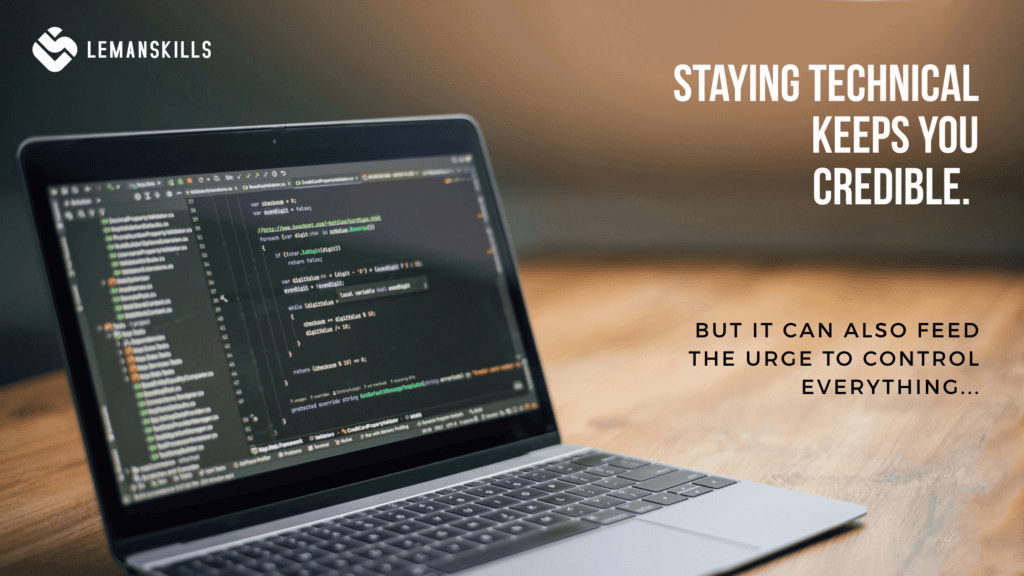
Most leaders who read “stay technical” hear permission to stay in every decision. There’s a real difference between staying close (informed, credible, able to ask a sharp question in an architecture review) and staying in control (the one person every decision has to pass through). The first builds trust. The second becomes the bottleneck nobody names out loud.
Piotr was honest about where his own control habit came from. Describing the early, scrappy years at Divante, before the company had any real margin, he said it plainly: we had no margin, so you’re over controlling, because you’re just afraid. When a company is small and every client is the difference between making payroll or not, tight control isn’t a character flaw. It’s survival math.
The problem is that most leaders never notice when the math changes. The company grows, the margin shows up, and the controlling habit stays exactly where it was.
What Changed After the Exit
After Piotr exited Divante, he described something a lot of leaders never get to experience: what it feels like to build without that constant fear underneath every decision. Building Open Mercato, his current company, he said delegation, hiring, and setting goals “works totally different than ten years ago.” He gives people real freedom now, not because he stopped caring about quality, but because he stopped needing to personally verify it.
This is where the conversation connected straight back to something I say in almost every mentoring session: somebody else’s 80% is better than your own 100%, because your 100% doesn’t scale past one person, and their 80% (with a bit of your feedback) compounds across a whole team. Piotr agreed instantly. He’d learned it the expensive way, through years of piling every task back onto his own plate because he knew he could do it faster himself.
Why Your Best People Feel It When You Can’t Let Go
Thinker-based engineers need to see demonstrated competence before they trust a leader. Over-control has its own signature, and it shows up most in exactly the two Bases you’d expect to be excellent under pressure:
If your Base is Thinker or Persister, depletion or fear tends to look like perfectionism and over-control. Nothing is quite good enough. Details that never mattered before suddenly matter a lot, and your team feels every one of those extra check-ins as a vote of no confidence, even when your intention was protecting the work.
If your Base is Promoter, the pattern looks different: you don’t hover over the details so much as you keep grabbing the wheel, because acting feels safer than waiting. Either way, your team doesn’t read it as “the leader is stressed.” They read it as “I’m not trusted to do this,” and that’s what quietly pushes your strongest people to stop bringing you their hardest problems.
The Research Backs This Up
This isn’t just a feeling. DDI’s Global Leadership Forecast found that only 19% of rising leaders demonstrate strong delegation skills, based on assessments of more than 70,000 manager candidates. And it isn’t a victimless gap: in the same research, 71% of leaders report significantly higher stress since stepping into their current role. Staying close was never the actual problem, for Marcin or for Piotr. The problem is what closeness turns into when it stops being about understanding the work and starts being about controlling it, and that control is quietly costing leaders their own bandwidth too.
Three Shifts To Make This Week
- Separate “close” from “control.” Before you step into a decision that isn’t technically yours to make, ask yourself one honest question: am I here to understand, or am I here to decide for them?
- Delegate to 80%, not 100%. Before handing off a task, say out loud what “good enough” actually looks like. Then let the last 20% (the part that would only match your exact style, not the outcome) belong to them.
- Name your own distress signature. If pressure turns you into a perfectionist or a control-grabber, that’s useful data about yourself, not a character flaw. Catch it early, before it hardens into how you lead every week, not just the hard ones.
Which one are you actually protecting when you can’t let go of something: the quality of the work, or your own sense of being needed?
PS. If you want a blueprint for how to lead a technology / IT team without burnout, grab “From Code to People“!