

Lemanskills.com

Team Conflict: Is It Always a Bad Thing?

When we hear “conflict”, we think “trouble”. When we hear “conflict”, we think “dysfunctional team”, where communication doesn’t work, and people have personal issues. Or when we hear “conflict”, we think that leader doesn’t know how to lead his/her team successfully.

Is that really true? Why are we so scared of a conflict? What is the worst thing that can happen when there is a conflict in the team? What kind of experiences we have with the conflict that make us think and behave in a certain way when one appears?

Why do we avoid conflict?

The real question should be: why do we avoid doing things in overall?

  • We have bad experiences from the past. We wanted to share a great idea with somebody, and as a response we got yelling and then being ghosted for a week. We gave feedback, with a good intention so a person can grow, and as a response we got attack and aggression. Based on that kind of experiences we decide (sometimes on the unconscious level) that we are not going to expose ourselves to those reactions. So, we just stop doing it, since it brought us more harm than good in the past.
  • Other people think that we should stay low. How many times did you hear: “stay low, don’t put yourself out there” or “maybe it’s not perfect, but at least you have a peace and quiet of mind”. Or “you should be happy about what you have, don’t risk it”. Speaking up requires putting ourselves in the spotlight and even when we just want to share another point of view, or we want to improve a way of working, there is always a risk of being somehow judged or attacked by people. If others are afraid of that kind of courage of speaking up, they will project this fear on us: just to make sure that nobody gets hurt (twisted logic). And if we trust those people, it’s a huge chance that we will listen to them and resign from making a change.
  • We have our own beliefs about something. What do you think about conflict: is it a good or a bad thing? Or maybe it depends? If we were exposed (as children and then, as adults) to the conversations where other people were discussing that a conflict is the worst thing that can happen and we should avoid it because it never brings anything good, how on Earth can we be open to it? It’s almost impossible, since our brain is soaked with this narrative and doesn’t have any other data that it can rely on to create a new belief. It’s applicable to every single thing that we avoid: we don’t do it, because our brain “protects” us from being hurt by potential consequences of that kind of decision.

In the area of conflicts, it’s extremely visible: we avoid it, because we burned ourselves once or twice. Based on that we make this strategy to not get involved in any kind of “risky” situation: so, we sit quiet and just focus on living through another day. Is it really the best option we can get?

When a lack of conflict is dysfunctional, not the other way around?

One of the biggest experts of team development and leadership, Patrick Lencioni, years ago wrote a book “5 Disfunctions of a Team”. It is a really short story (doesn’t even look like a personal/professional development book), yet it’s very powerful. And there is one part that stopped me when I first read it: Lencioni says that one of the dysfunctions of a team is a fear of conflict.

What?
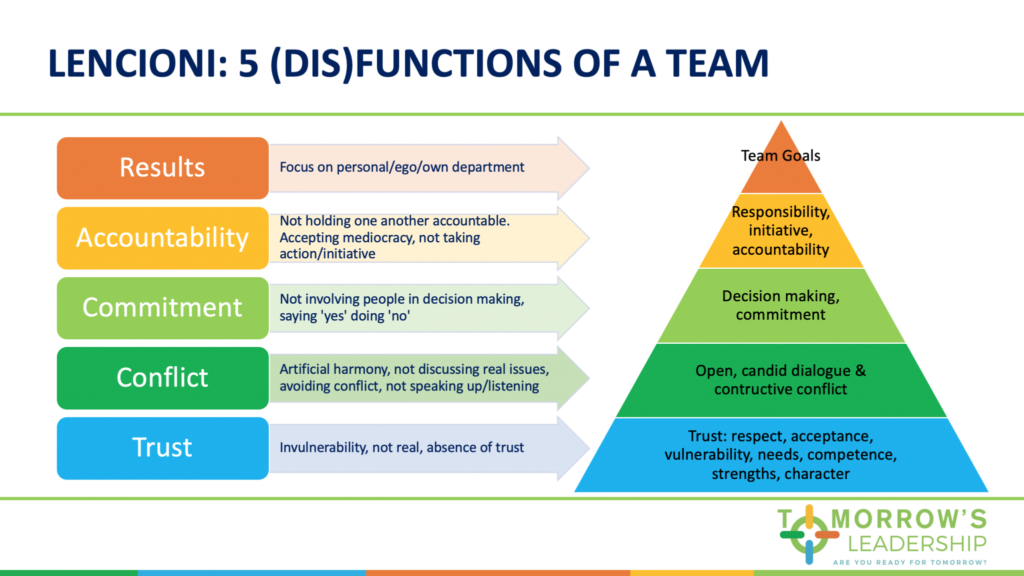
(On the chart on the left-hand side there are definitions of all disfunctions and on the right-hand side there are solutions, that answer the questions: what is the best thing we can do here for our teams?)

If we stick to our old believe that a conflict is something negative and destructive – that it ruins the trust and good atmosphere in the team, how is it possible that it’s actually the other way around?

When we avoid conflict, not speaking up and be open about what do we really think, feel, or observe in the workplace, there is a huge risk of not being as effective and efficient as possible. It’s also short sided: if we are not sharing it now, it’s going to backfire in the future. So, at the end of the day, it will bring worse result than we imagine now. What’s even worse, people probably will talk behind other colleagues’ or leader’s backs, and not saying anything out loud. We can imagine that it will bring even worse outcomes, like really ruining the atmosphere, creating space for psychological games and in a consequence: lack of trust.

The fear of conflict can be one of the biggest barriers that will stop people from growth, thrive and being the best versions of themselves in a workplace. What can we do to change this mindset?

How can we use conflict that nourishes our team?

The key thing to understand is that a certain kind conflict is something that we can use. Sometimes it is, sometimes it isn’t, it really depends on what we are dealing with.

There are 2 categories of conflicts, I call them functional and dysfunctional.

  • Functional conflicts are when there is a space for people to have a discussion, create a new product, service or idea that can be reshaped in something groundbreaking. It happens when two (or more) people are really passionate about what they do, and they want to create the biggest possible value for others. If you are a manager, you can use this occasion to create a safe environment, where people can discuss with a minimized risk of having a destructive argument. That way you make sure that they have a contract for this discussion, good intention of creating something, not to be mean to each other (or prove the other person that their point of view is worse or not worth anything at all). Be a moderator, guard of the conversation, support when needed and make sure that the conversation nourishes both sides.
  • Dysfunctional conflicts are when they fit into one of the types on the Wheel of Conflict (created by Christopher Moore).
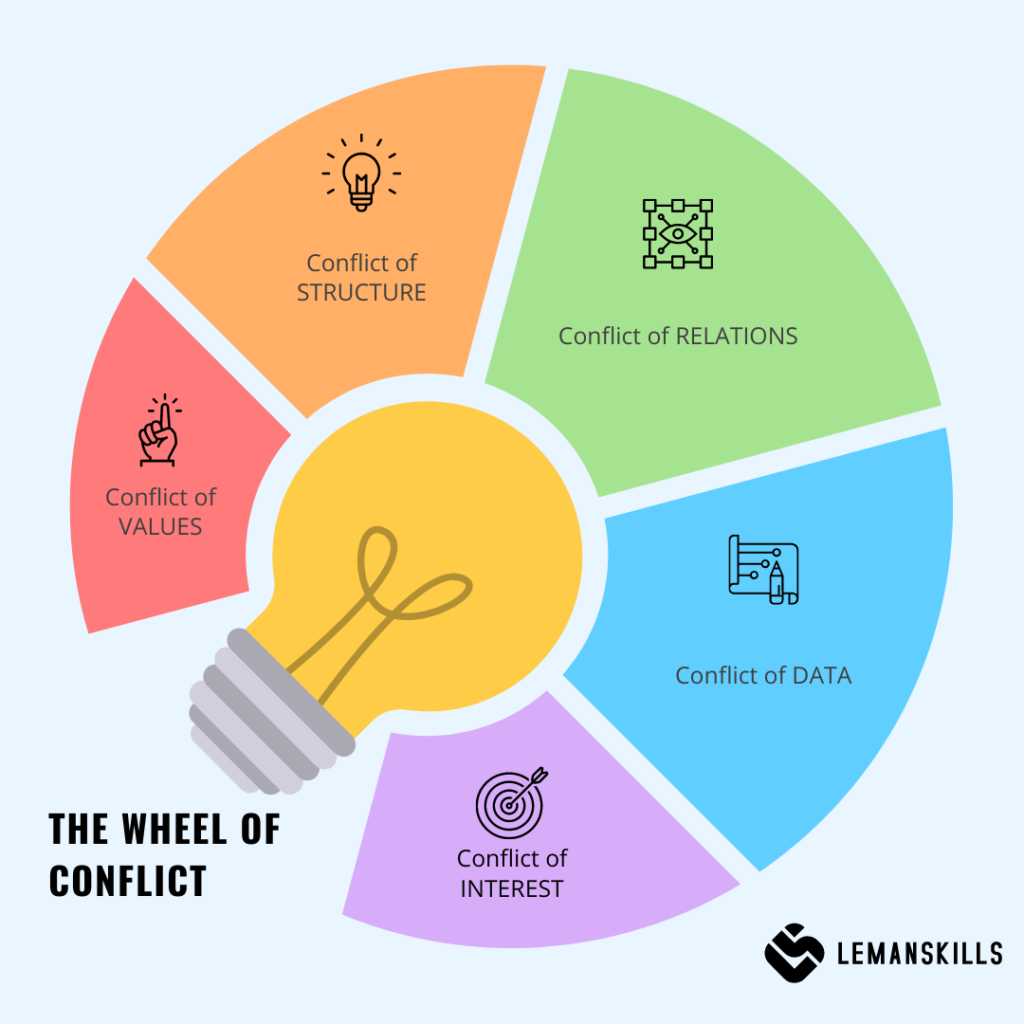
  • Conflict of data is when we miss some pieces of information. It’s like having an Excel spreadsheet where there are blanks in some cells and in consequence formulas don’t work. It can also happen when two people understand one thing in a different way (have different frame of reference).
  • Conflict of structure is when there is a lack of clear scope of responsibilities between people/teams, the processes or policies are not working (or they don’t exist at all). It can also happen when there is a lack of contract (we don’t know who is responsible for what, when and why).
  • Conflict of interest is when one side has their own goals that are contradictory to those that the other side has. A great example is a salesperson and a service person: the first one’s goal is to sale as much as possible, and the second person is responsible for the best quality of service, while taking care of the same customer. The first one has bonus from each customer, and the other has a bonus from not-returning-with-questions clients. Completely different focus.
  • Conflict of values is when we have religious or political differences, that are influencing our ways of living or are a base of what is important and not-negotiable for us. This type of conflict is not solvable, we can only agree to not bring those subjects to the conversation or mediate when it influences our workspace somehow.
  • Conflict of relations is at the end of the cycle. The interesting thing is when we think about conflicts, the first thing that comes to our mind is “people are not communicating well” or “they don’t like each other” – we don’t dig deeper into first four types of conflict. The truth is that conflict of relations is at the very end, mostly as consequence of one (or more) of the previous ones. It’s happening when we communicate badly, we use stereotypes in our way of thinking, can’t deal with strong emotions that we experience, or we repeat other negative behaviors.

What can we do with the dysfunctional conflicts? First and foremost: we need to map and name correctly which conflict is the real one in the situation we are dealing with. Without that, even the most beautiful strategy is not going to work, because we are going to answer to the wrong need. We’ll get frustrated and use all our energy badly. Focus on investigating will bring the best results, since then the solutions will be to the point: it’s more than certain that it’s worth investing time in this process.

The bottom line

The conflict is a huge, hairy, and scary thing that we often have very strong convictions about. We avoid it, by staying low, don’t speak up to not get into any confrontation. We do it because we don’t want to get hurt, expose ourselves to bad emotions, stress or feeling that we do not belong. Perfectly natural, there is nothing to be ashamed of.

When we make a mindset shift: from fixed (focused on avoiding conflict) to a growth one, where we take into consideration that the conflict can be good for us, nourishing and interesting, we can gain more than we think. With remembering about having a good intention, being in OK-OK zone and with a goal of creating something extraordinary as a consequence of a passionate discussion, we can achieve the outcome that won’t be possible to achieve on our own.

It puts old, good conflict in a completely new light. I believe it’s worth trying if it fits.

Udostępnij

Komentarze

0 0 votes
Article Rating
Subscribe
Notify of
0 komentarzy
Oldest
Newest Most Voted
Inline Feedbacks
View all comments

Czytaj także

Leadership

The Number One Struggle of New Tech Leaders (And How to Navigate It)

You’ve just been promoted. The title changed from Senior Developer to Engineering Manager, from Tech Lead to Director of Technology. Congratulations—you’ve worked hard for this moment. But then reality hits. Your inbox explodes. Slack messages pile up faster than you can read them. You’re pulled into meeting after meeting. Your calendar looks like a game of Tetris gone wrong. And that code you used to write? That deep work you loved? It’s now squeezed into whatever gaps remain between 1:1s, stand-ups, stakeholder updates, and strategic planning sessions. Welcome to the number one struggle every brand-new leader in technology faces: Communication overload. The Hidden Cost of Being “Always On” Here’s what nobody tells you when you step into leadership: Your job has fundamentally transformed from creating solutions to constant communication. And the data confirms this shift is real—and overwhelming. According to Grammarly’s 2024 State of Business Communication Report, developed with The Harris Poll, knowledge workers now spend 88% of their workweek communicating. For new tech leaders juggling team management, cross-functional collaboration, and strategic initiatives, that percentage often exceeds 100% of a standard work week. The report reveals something even more alarming: in the past 12 months, 78% of professionals saw increases in communication frequency, while 73% are using more communication channels than ever before. For HR teams and large organizations—exactly where many new tech leaders find themselves—many report spending over 40 hours weekly on communication alone. Think about that for a moment. Communication isn’t just part of the job anymore. Communication is the job. Why New Tech Leaders Feel it Most Intensely? As someone who works with hundreds of tech leaders each year through workshops and one-on-one mentoring, I see this pattern repeatedly. New leaders get caught in what I call the “triple communication trap”: You haven’t let go of your Individual Contributor identity. You were promoted because you were exceptional at solving technical problems. Your brain is wired to think in code, systems, and architecture. But now, your value comes from enabling others to do that work. This identity shift is brutal, and most new leaders try to do both—leading AND coding—which doubles their communication load while halving their effectiveness at each. You lack Communication Intelligence (CQ). We invest heavily in developing technical skills—learning new frameworks, mastering cloud architectures, and understanding AI/ML pipelines. But communication? We assume it’s intuitive. It’s not. Just as you wouldn’t expect someone to write production-ready code without training, you can’t expect leaders to navigate complex human dynamics without developing their Communication Intelligence. As I explored in the article on Communication Debt, many organizations suffer from a severe lack of investment in communication processes. New leaders inherit this debt without realizing it, then struggle to understand why their teams seem disengaged or why projects constantly fail due to “miscommunication.” You’re drowning in channels without a strategy. Email. Slack. Teams. Zoom. Jira. Confluence. GitHub comments. The average tech leader toggles between 8-10 communication platforms daily. Research shows that 55% of professionals say the constant flow of notifications across channels makes it hard to concentrate on important tasks, and 47% feel unsure about selecting the right channel to communicate information. Without a clear communication strategy, new leaders respond reactively to whatever channel screams loudest, creating a perpetual state of context-switching that destroys productivity and cognitive capacity. The Real Price We Pay The communication crisis in tech leadership isn’t just about feeling busy. It has a measurable business impact. Grammarly’s research found that poor communication costs businesses $1.2 trillion annually through lost productivity, elevated turnover, and customer churn. For a single organization, business leaders estimate teams lose 7.47 hours weekly to poor communication, equating to $12,506 per employee yearly. But here’s what hits new leaders hardest: This isn’t about others failing to communicate well. It’s about you learning to communicate strategically as a leader. And nobody taught you how. The consequences compound quickly: Your team becomes disengaged because they’re unclear about priorities and expectations Projects slip because cross-functional alignment fails Top performers leave citing a lack of clarity and direction You burn out trying to be everywhere, for everyone, all the time According to Gallup’s State of the Global Workplace 2024 Report, only one in three employees is engaged at work, and burnout continues to rise. New leaders, trying to prove themselves while learning their role, often push themselves beyond sustainable limits. Two Strategies to Navigate Communication Overload After working with tech leaders across organizations ranging from startups to global enterprises, I’ve identified four core strategies that make the difference between drowning and thriving. #1 Contract and Re-Contract Constantly Most new leaders assume their team knows what’s expected. They don’t. The contract you think you have—about goals, responsibilities, communication norms—exists only in your head. I teach leaders to avoid the toxic questions “Do you have any questions?” and “Is everything clear?” These prompts trigger social pressure to say “yes” even when confusion reigns. Instead, try: “I want to check if I explained this clearly. Can you describe back to me how you understood this?” This simple shift transforms an assumption into confirmation. Do this weekly with your team. When circumstances change (and in tech, they always do), re-contract explicitly rather than making unilateral announcements. #2 Develop Your Communication Intelligence (CQ) Just as you learned technical skills through deliberate practice, you must develop CQ intentionally. This means: Understanding that different people need information delivered in different ways Learning to read behavioral cues that signal misunderstanding or disengagement Recognizing your own communication preferences and consciously stretching beyond them Investing 10-15 seconds at the start of each interaction to observe how the other person communicates, then tailoring your approach Most communication is tailored to ourselves, not to others. We like detailed written documentation, so we send 10-page specs. We prefer face-to-face conversation, so we schedule yet another meeting. Strategic leaders adapt their communication to what works for their audience, not what’s comfortable for them. One CEO I worked with replaced weekly status meetings with short “mission huddles” focused on priorities and

Czytaj dalej
Leadership

Do You Want More Visibility as a Leader? Here’s How to Do It.

To have a greater impact as leaders, we need to be more visible. I know that you would prefer the scenario: “Who needs to know, they know” or “Our product is going to speak for itself”, but the truth is that getting people know about what you do is something that’s not just happening. We need to speak up about our ideas, about what we’ve done, what we’ve designed, what we want to change, or what we’ve changed already, because nobody’s going to notice that on their own. Nobody’s going to guess that it is important, to assume that it’s somehow valuable. Harsh, but true. So today I want to focus on what we can do in practice to build more visibility. I’m going to share with you some of my own strategies, so you can just take, copy, and paste them, adding a little bit more flavour to your individual situation. We are going to divide those things into internal and external leadership visibility strategies.     How to Build Visibility Inside the Organization?   If you’re working in the organization: It can be a big organization / a corporate world, or in a smaller organization, but you are inside, what can you do to build your visibility? First, you have your team level. I’m sure that you have some team meetings, knowledge sharing sessions, weekly meetings, retrospectives; depends on the setup that you are working in. These are the places that are already designed for you to share knowledge, experiences, lessons, mistakes, or failures (with lessons learned) that you can show to others. When you speak up, this is always something that makes you more visible. So even if you’re a Base Imaginer, Base Thinker who has the preference to not speak up very much, I would like you to challenge yourself a little bit to be more verbal. I know that you believe that if you work hard in silence, you create valuable solutions to the problems the organization or clients face, the other people will notice you. I don’t want to be a dream-crusher here, but it’s just not going to happen. People are very focused on their own things and don’t have much spare energy to look around. You need to show them. So, I invite you to do one thing like that per week, in a bi-weekly meeting, or once per month. Start small: The goal is for your brain to see that it makes sense and is worth the stretch. Share something that you’ve created, optimised, or automated recently.  Don’t make it complicated, just use what you’re already doing in your work. The second thing you can do is to share knowledge by sending some links to the podcast episodes that were interesting for you to others, a book you’ve read, a YouTube video you watched, or a digital course you’ve taken. I’m sure that you have some Teams / Slack / WhatsApp group in your company where you share some stuff. Leverage that: Share links to YouTube videos, to TED Talks, to podcasts, to books, to articles, to documentation, to Reddit, basically anything that you’re using to get knowledge. Share that with others with a short comment like: Hey! I’m sharing this as something interesting…, It helped me in a way that…, Check it out!”. Easy. You don’t even need to speak up verbally; you just copy and paste a link. But again, it puts you on the map that you share things with others. That way, you can become a go-to person for people who are looking for a certain answer or a source of knowledge. Being a go-to person builds visibility. Start with the team level and then move up. What can you do on the organizational level? Be the voice. The voice of the change or a project. Engage yourself in the project or initiative team, even if there is some extra work to do. You can always make a contract with your boss to be redirected when it comes to your work to a little bit to some project that is maybe like a matrix project in the organization. Maybe this is something different. Maybe this is something that you never done before. Being more visible by creating value is one of the most important things in organizations. The good news? It is not about speaking up all the time. It’s about being visible by being engaged. Of course, you can make some presentations, being a face of the project or initiative, during the Town Hall meeting, some other online or onsite gatherings. Even better! Check out what kind of possibilities there are in your organization that you can leverage. Be a mentor or a buddy for new joiners, or let others shadow you. There are more things you can do than you think. Choose what works for you, start with one thing, and then move to another one if you want.   How to Build Visibility Outside the Organization?   If you are outside of the organization: Maybe you are a consultant / a Fractional CTO / COO, etc.; if you are running your own business: you’re an entrepreneur, a Founder, you can do many things. And if you’re inside the organization, you can use some of those as well (these strategies are not reserved only for “the externals”). First, blogging. You can say that blogging is dead, but it couldn’t be further from the truth. People like to read, especially short forms. Because if you are a visual person, what you read sticks in your brain. So, blogging can be your visibility builder, especially when you take care of the SEO. It can be very well-positioned in Google and in AI tools where people are researching things. It is super easy and low-cost to start. Just start writing down what you know about. Share your expertise, research, pieces of lessons that you have, failures, and success stories. People love reading about those things. The second

Czytaj dalej
Leadership

Why Are We So Frustrated as Tech Leaders?

Just think about it for a moment. When was the last time you were angry, pissed off, or frustrated with the other person as a leader? Your direct report didn’t deliver something on time or to the quality that you wanted them to deliver? A person promised to do something, and they didn’t? Or a person asked you a question, you answered, and then they came back with the same question one time, two times, three times, five times? When was the time when you agreed on something? You made a contract on who is doing what:  With the client, a contractor, or a vendor; you delivered your part, and they didn’t? Or they did, but the quality of the work was not so good, and you got angry, you thought a lot of not-so-nice things, and maybe you even behaved in an aggressive way. If you’re nodding right now, you’re in the right place. In this article, I’m going to give you answers on why you get so upset when things like that happen, and what to do to manage it better. Let’s go into it. Why am I reacting like that? Do you know people who, even if something’s going on, are calm? It might seem that they don’t even care when you look at them. They’re all chilled out. And then, it’s you: Frustrated, angry, mad at others. Burning up, losing energy, and being exhausted at the end of the day. Is it your reality? If yes, it means that from a personality perspective, you have a strong Thinker or a Persister floor in your Personality Condo. Maybe a Promoter as well, if you are getting angry with people for being too slow (in your frame of reference, of course). It means that your beliefs about yourself in the world go like this: Thinker: “People need to be competent, deliver work on time, efficiently covering what’s there to be done”. Persister: “People need to be trustworthy, fulfilling the contracts that we have for delivering things, following processes we have in place”. Promoter: “People need to be strong, fast, and self-sufficient. They need to act, instead of talk or analyse all the time”. If we have convictions like that in our brains, and it is our default way of working, every person who’s not doing things like that will make us angry or resentful. It’s mostly unconscious, and until we start learning more about Communication Intelligence (CQ), it’s an automatic thinking pattern we go into in every situation that jeopardises how we think the world should look. Eustress vs Distress The answer to why we’re reacting in an aggressive or manipulative way when we have those thoughts in our brains is that we are in distress. Let’s unpack the stress part, since it’s not very often described in two ways: Eustress and Distress. Eustress is a positive stress. It: mobilizes us to take action; positively influences ourselves and people around us; keeps us in strengthening beliefs, pushes us to do things that bring extraordinary results. Eustress is a feeling of excitement, a little bit of adrenaline rushing through our veins, making us brave to go into the uncomfortable. Like being on the stage, sharing things we are truly passionate about with the thought in our brains that we can really change something while sharing it with the world. But, as always, there’s a dark side to the story. Distress is a negative stress. It: is an automatic sequence of thinking, reacting, and doing things (or not doing them at all); negatively influences ourselves and the people around us; keeps us in limiting beliefs, takes us away from the access to the resources we have in ourselves (intellectual, emotional, cognitive, etc.). We go into distress most of the time right away in two situations: We don’t have our physiological needs covered; We don’t have our motivational / psychological needs covered. So, if you’re hungry, thirsty, you haven’t been in the bathroom for hours, you lack sleep or physical touch of a close person, your body is upset, which makes it distressed. And if your motivational needs connected to your personality Base are not covered, your brain and soul are upset, which makes it distressed. Distress is visible when we are anxious, our heart is beating fast, our blood pressure is high, our voice, hands, and knees are shaking, sometimes we have a sore throat, and we can’t even say a thing. It’s when we forget everything we wanted to say, even if we’re well-prepared and equipped. It’s when we lose the brain-spine connection, and we start to behave extremely weirdly, like we’re not ourselves anymore. That’s where the anger, frustration, and consequently, burnout comes. What can we do about it? The awareness is one thing (super important), but action is crucial. Some things will be transferable for every personality Base, and some will be tailored. Let’s start with the individual ones, connected with the 3 types we’ve talked about above: For Thinkers: Make clear contracts, share tasks and responsibilities transparently, and put deadlines whenever you can. Ask for feedback for your efficient work delivered regularly. Structure your day / week, book slots for deep work in your calendar, and protect your time. For Persisters: Make clear contracts, double-check if people have everything they need (resources, skills, technology, etc.) to work efficiently. Ask for feedback for your principled work regularly. Share your convictions with others and have a conversation when you can gather positive recognition for what you believe in. For Promoters: Make a plan and follow it. Remember that not all people work as fast as you, so give them more time before the deadline is due. Take care of the diversification of what you do, so you don’t get bored too quickly. Plan some adrenaline rushes in your private and/or work life. The things you can do to protect yourself from going into distress that are universal to all personality bases are not fancy. I don’t think

Czytaj dalej
0
Would love your thoughts, please comment.x
()
x