Lemanskills.com

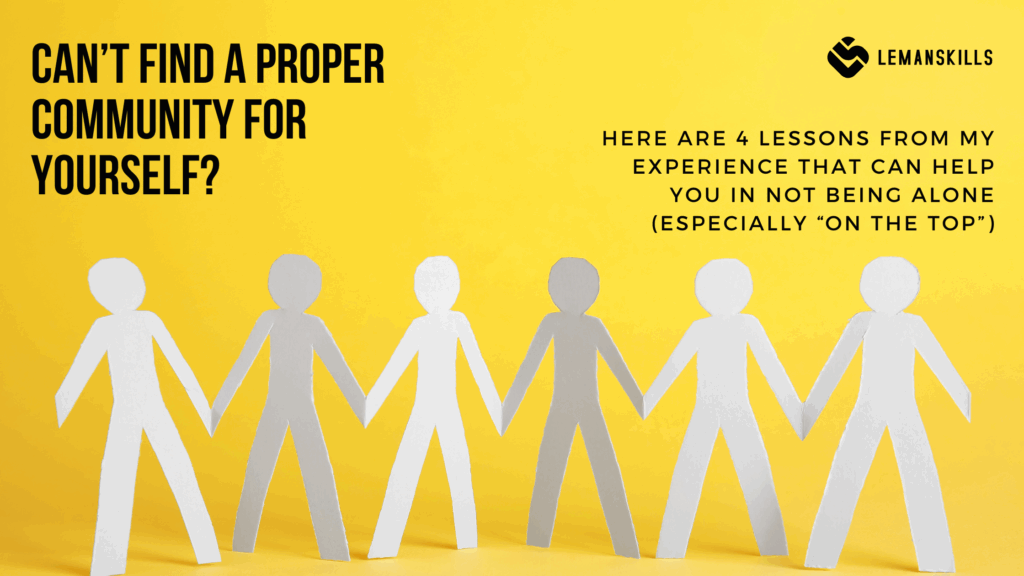
4 Things I’ve Learned About Looking For a Community

You know what they say: It’s always lonely on the top.

Whatever the “top” means. Being in the board or executive team in the organization, a founder or co-founder of a startup, entrepreneur in overall. Being a top athlete, art creator, innovator of any kind. Visionary that no one really understand because their brain works in the modalities that are not available to most of the people.

There are even books, articles, podcast episodes that are saying that there’s a cost of being “on the top”: Loneliness and alone, hard journey.

But you know what? The last years of being an entrepreneur showed me that it’s bullshit. You don’t need to be alone, and I’ll go even further: You can’t be. Because it’s extremely hard to juggle all those hats and tasks we have on our lists to do it all on our own. Community can be the answer.

That’s why I’ve decided to start looking for people who can be with me on this journey. Here’s what I’ve discovered so far (because it’s still an unfinished project) that I believe can be helpful for you in hunting for a great community for yourself.


#1 Your family and friends usually aren’t the best option


If you have around you people who are your cheerleaders, they support you in your work-related decisions that’s great. Not a common thing, though: I am familiar with many experiences (my own and different people I worked with or be friends with in the past) that have quite the opposite ones. Here are few examples (quite nice one, since I know also more aggressive options):

  • “You should be happy about what you have, why you need to change something?”
  • “If you risk, you can lose what you’ve already have.”
  • “Maybe it’s not the best idea, stay where you are and enjoy it.”
  • “You’ve never done something like this before.”


If we think about it deeper, most of the time people don’t’ have bad intentions while saying that kind of things. They mean to protect us, reduce the risk of the failure, disappointment, loss. The truth is that most of those behaviours have a root cause in their own insecurities, fear and bad experiences from the past. Or sometimes unconscious jealousy: Because they’ve always wanted to do something like that, but they’ve never had enough courage or skills to do so.

That’s why quite often people that are the closest to us are not the best when it comes to our community. The only exception I see is that they are also experts in our field and they are extremely flexible when it comes to changing the hat that they’re wearing at the certain moment. Then they can be our spouse in one moment, and the other entrepreneur in the next one. But let’s be honest here: That’s a rare situation.

And it’s not about that they are bad people. They really aren’t. But we don’t need the second thoughts in our brains (more that we already have on our own). We don’t need second guessing our decisions, giving our brain more holes of fear to go into.

I’ve heard years ago this, and I stick to it ever since: “I don’t take business advice from people who never ran a business. I don’t take parental advice from people who don’t have kids. I don’t take relationship advice from people who can’t build a healthy relationship.” Finding a community outside of your closest circle can be so much better for you, and for your friends & family as well.


#2 Looking for community is not a weakness. It’s a strength.


For a very long time in my life, I had a strong belief that I need to do everything on my own. That I need to be strong, look for answers on my own, even if it takes a lot of time and effort. It was a pattern that I’ve got in my childhood, and it helped me in many situations, but in my middle 30s is not as useful as before anymore.

We all have patterns in our brains. Most of them are unconscious, printed in our wiring since we were kids. They were mechanisms that supposed to be the best solution to be worthy of love and attention of our caregivers. They answered the question: “Who do I need to be / How should I behave to “be worthy” of those who I crave the most?”

And I remember that situation from my childhood where I asked a question about something and I’ve got and answer: “Go and find it in the book on your own”. It doesn’t look angry or hurtful, but it put a seed in the small person’s brain that’s saying: You can’t reach out for help, you need to do everything on your own. Sounds familiar?

That’s why so many people are struggling with looking for a person, group of people or a bigger community that consists of like-minded people because they still have those beliefs that are not serving them anymore. There was a copying mechanism for a child we are not as adults. I know for me it was a journey and a healing process to go through, so my brain rewires into a new belief. There’s nothing wrong with reaching for support. I’ll go even further again: It’s a sign of strength, wisdom and an ability to use one’s resources the best possible way. Because from the rational and logical perspective we do know that if I ask somebody for something, there’s a bigger chance that I’ll resolve my problem faster. 80% of the problems I had in my past somebody else already experienced or they know somebody who did! So why wasting time and energy that we can reinvest in something else that creates more value?


#3 Put yourself in the rooms where there are people who have what you want to have


A couple of years back I was tired of being the smartest person in the room. I read a lot, learn all the time, listen to podcasts compulsively, now recording my own show. I teach what I learn, write articles, give keynote speeches. And I don’t’ say it to brag, I just want to say how much my passion to change the leadership and organizational world expand my brain.

I didn’t have in organizations I’ve joined anybody I can learned from. At least those things I wanted to learn (I’m not saying people weren’t competent in SOME areas). So, I’ve moved to another, then another one but something was still missing.

Then I’ve decided to build my own company, and it showed me the whole new world: Entrepreneurship. Suddenly, I needed to wear 10 new hats I’ve never had on myself before and it was a shock to my body at first. A person adapts to anything but it’s not as easy as it looks like from the outside.

Learning how to be an entrepreneur taught me (so far) that I need to be in the rooms with people who are successful in what I want to achieve. Because if I am only in the circles with people who are beginning or are on the same level as I am, I listen to my stories, problems, struggles all the time. And I’ve discovered that’s exhausting and draining from the energy and inspiration I need to go into the next level.

Sure, being in the rooms and talking with people who are smarter, more successful, who already build a bigger business is uncomfortable. But asking them questions, talking to them, listening to their stories and how they make decisions is how I learn. Even if it’s super uncomfortable and if I feel extremely tiny in compared to what they’ve achieved. But I also realised that it’s unreasonable to compare my situation to theirs: My level 5 to their level 500 in this game. It’s going to be frustrating, and I can lose faith and momentum with what I do. But I can learn from them and community that is around them to not make stupid mistakes, just because I’m not in proximity to those stories.


#4 Energy is a real resource


I am a very energetic person. A lot of people that come to my speeches, workshops or joining 1:1 mentoring processes are saying: “Alex, where you have all this energy from, that’s amazing?!” I believe that energy is a strong power. If we are low in energy, we talk and walk like we want to die, it’s the clear sign to the universe that we gave up. And let’s be honest here: People don’t want to be surrounded by energy vampires. Unconsciously we are more willing to spend time, do business or learn from people who have a good energy, not those who are walking corps.

This is what I learned as well: Look for communities where there are people with good energy and they want to do things. We all have bad days or periods, sure. But if there are people who whine all the time, who are blaming everything and everybody for what happens to them, not looking for solutions or opportunities, only seeing problems and constraints… I’m out.

I do so many things to keep my energy up: feeding my brain with good content, not watching TV, reading news or scrolling social media; moving my body every day, doing my best on feeding my body with good foods; being wise when it comes to choosing who I spend my time with (in person and in virtual contact), sleeping well. I invest so much energy in all of those that I really don’t want to waste it on the community where there’s negativity, and people are meeting only to gather around what doesn’t work or how bad their current boss or organization is.


The bottom line


People are important. Even if you have a personality base that prefers to be alone or in 1:1 setup, you don’t want to be alone all the time. We need smart people around, those whom we can bounce thoughts, ask for opinion or feelings on a certain idea. Those whose genius zone is where we don’t have a lot of skills (yet!), and that can give us a solution we can tailor to our needs and use.

But it’s not just any people we need. We need those who can give us value, good energy and who can feed our growth mindset even more. Who will show us a different angle of a certain situation, sometimes hug, sometimes slap in the face when we need it. Look for a community that will cover those needs. There are there, all around the world that is wide open. We don’t need to be alone.

We just need to start looking better.

Udostępnij

Komentarze

0 0 votes
Article Rating
Subscribe
Notify of
0 komentarzy
Oldest
Newest Most Voted
Inline Feedbacks
View all comments

Czytaj także

Leadership

Why Are We So Frustrated as Tech Leaders?

Just think about it for a moment. When was the last time you were angry, pissed off, or frustrated with the other person as a leader? Your direct report didn’t deliver something on time or to the quality that you wanted them to deliver? A person promised to do something, and they didn’t? Or a person asked you a question, you answered, and then they came back with the same question one time, two times, three times, five times? When was the time when you agreed on something? You made a contract on who is doing what:  With the client, a contractor, or a vendor; you delivered your part, and they didn’t? Or they did, but the quality of the work was not so good, and you got angry, you thought a lot of not-so-nice things, and maybe you even behaved in an aggressive way. If you’re nodding right now, you’re in the right place. In this article, I’m going to give you answers on why you get so upset when things like that happen, and what to do to manage it better. Let’s go into it. Why am I reacting like that? Do you know people who, even if something’s going on, are calm? It might seem that they don’t even care when you look at them. They’re all chilled out. And then, it’s you: Frustrated, angry, mad at others. Burning up, losing energy, and being exhausted at the end of the day. Is it your reality? If yes, it means that from a personality perspective, you have a strong Thinker or a Persister floor in your Personality Condo. Maybe a Promoter as well, if you are getting angry with people for being too slow (in your frame of reference, of course). It means that your beliefs about yourself in the world go like this: Thinker: “People need to be competent, deliver work on time, efficiently covering what’s there to be done”. Persister: “People need to be trustworthy, fulfilling the contracts that we have for delivering things, following processes we have in place”. Promoter: “People need to be strong, fast, and self-sufficient. They need to act, instead of talk or analyse all the time”. If we have convictions like that in our brains, and it is our default way of working, every person who’s not doing things like that will make us angry or resentful. It’s mostly unconscious, and until we start learning more about Communication Intelligence (CQ), it’s an automatic thinking pattern we go into in every situation that jeopardises how we think the world should look. Eustress vs Distress The answer to why we’re reacting in an aggressive or manipulative way when we have those thoughts in our brains is that we are in distress. Let’s unpack the stress part, since it’s not very often described in two ways: Eustress and Distress. Eustress is a positive stress. It: mobilizes us to take action; positively influences ourselves and people around us; keeps us in strengthening beliefs, pushes us to do things that bring extraordinary results. Eustress is a feeling of excitement, a little bit of adrenaline rushing through our veins, making us brave to go into the uncomfortable. Like being on the stage, sharing things we are truly passionate about with the thought in our brains that we can really change something while sharing it with the world. But, as always, there’s a dark side to the story. Distress is a negative stress. It: is an automatic sequence of thinking, reacting, and doing things (or not doing them at all); negatively influences ourselves and the people around us; keeps us in limiting beliefs, takes us away from the access to the resources we have in ourselves (intellectual, emotional, cognitive, etc.). We go into distress most of the time right away in two situations: We don’t have our physiological needs covered; We don’t have our motivational / psychological needs covered. So, if you’re hungry, thirsty, you haven’t been in the bathroom for hours, you lack sleep or physical touch of a close person, your body is upset, which makes it distressed. And if your motivational needs connected to your personality Base are not covered, your brain and soul are upset, which makes it distressed. Distress is visible when we are anxious, our heart is beating fast, our blood pressure is high, our voice, hands, and knees are shaking, sometimes we have a sore throat, and we can’t even say a thing. It’s when we forget everything we wanted to say, even if we’re well-prepared and equipped. It’s when we lose the brain-spine connection, and we start to behave extremely weirdly, like we’re not ourselves anymore. That’s where the anger, frustration, and consequently, burnout comes. What can we do about it? The awareness is one thing (super important), but action is crucial. Some things will be transferable for every personality Base, and some will be tailored. Let’s start with the individual ones, connected with the 3 types we’ve talked about above: For Thinkers: Make clear contracts, share tasks and responsibilities transparently, and put deadlines whenever you can. Ask for feedback for your efficient work delivered regularly. Structure your day / week, book slots for deep work in your calendar, and protect your time. For Persisters: Make clear contracts, double-check if people have everything they need (resources, skills, technology, etc.) to work efficiently. Ask for feedback for your principled work regularly. Share your convictions with others and have a conversation when you can gather positive recognition for what you believe in. For Promoters: Make a plan and follow it. Remember that not all people work as fast as you, so give them more time before the deadline is due. Take care of the diversification of what you do, so you don’t get bored too quickly. Plan some adrenaline rushes in your private and/or work life. The things you can do to protect yourself from going into distress that are universal to all personality bases are not fancy. I don’t think

Czytaj dalej
Leadership

Why So Many Tech Leaders Don’t Listen?

Communication Intelligence is always first about understanding what we do. And there’s one skill in there that a lot of Tech Leaders are not treating with respect. Not a lot of them focus on that one, and it costs a lot. I’m talking about the listening skills. When I was doing the research for the book that I’m going release soon, I was thinking about different angles of CQ. All of the algorithms that people are using consciously or mostly unconsciously when communicating with other people, especially when being leaders. And there are so many courses, books, podcast episodes, articles, YouTube videos, and TED Talks about speaking, public speaking, or speaking to others. But it dawned on me that there are not a lot of courses and other sources of knowledge about listening. And I’ve started to wonder why that is. I think it is because we think that listening is so easy. You just need to sit and listen, right? Nothing further from the truth. To make a little mindset and skillset shift in this area, today I’ve decided to give you 4 types of listening and some active listening tools and techniques for tech leaders. Let’s dig in! 4 Types of Listening There are 4 types of listening that tell us more about our intrinsic, mostly unconscious motivations: Why do we even go into the conversation with other people? Listen to reply. This is what most of the people do. We listen only to make a moment for ourselves to tell something. We are not listening for other reasons. And if we have this habit of not interrupting, we just cannot wait to jump in and say something. Most of the time, for us is to share information. So, saying what we know, what we have in our brains. We are not there to do anything more than reply. Listen to understand. In this type, people paraphrase, they ask additional questions; they can tell something like: “OK, this is interesting; tell me more.” They can say something with their own words, like: “OK, so I understand from what you’re saying that… Is that correct?” It is to understand, without guessing. Listen to connect. When people want to connect with us, they go deeper. They talk about something important for them, and they share reflections, opinions, values, thoughts, or emotions. They want to connect and find something meaningful for both sides. So, they ask more, they are more attentive, they’re curious about the other person, with an intention to build a relationship (regardless of the context). Listen to co-create. I’m listening to you to create something together, to make some value, to create a solution, to solve a problem, to create a functionality together, or to make a change. We are co-creating something, building a thing that can be valuable or useful for other people. So, I’m listening to what you’re saying, you’re listening to what I’m saying, and we make the synergy from those two things to create something together. Statistically, most people are listening only to reply. Secondly, they listen to understand. Then they listen to connect with some, and very few listen to co-create. The question is: Why is it happening in that order? From my observations and experiences with different leaders, teams, and organizations, it happens because of the way we work and the pressure we have (external and internal). So, my advice for you here is to just reflect on what you do. Next time, when you are going to have a conversation with somebody, just be more aware of how you respond to them and what you’re doing. What do you have in your brain? What is your priority for the conversation? What is the goal of the conversation? It can be private, and it can be professional (maybe private even is going to be more insightful). If you’re only talking, talking, talking, talking to vomit information on the other… Make a pause and observe: “Hey, I’m doing it. How can I be in a different bucket, more curious about the other person, more attentive to what they’re saying, more observant of them?”. Start with that small step, notice the difference. And how to do it? Here’s a list of simple techniques to strengthen your listening leadership muscle. Active Listening Techniques for Tech Leaders   #1 Paraphrasing It’s literally repeating what the other person said with a few different words. It’s the simplest tool to check if you got what was told, not assuming that you did. You can start with: “What I’m hearing is…” or “From what you say, I understand that…”. Facts, not opinions. Even if you are a Base Persister, you need to stick to the information without using much of your own frame of reference. Paraphrasing is for you to confirm understanding and de-escalate any misunderstandings that can appear during the conversation. #2 Asking open-ended questions This is the one that a lot of people struggle with. What I observed over the years of working with people from different cultures, it differs from culture to culture. Some countries have a preference to ask closed-ended questions to maintain harmony and avoid confrontation (i.e., Poland, Japan, Korea, Latin America, India). And some of them ask more open-ended questions to drive clarity and efficiency in discussions (i.e., USA, the Netherlands, Sweden, Denmark, Arab countries). Asking closed-ended questions is fine if you want to get a straight, yes/no answer. But especially during workshops when we train with leaders on how to give feedback or just use the requestive PCM® channel, it appears how often they use this type of question by coincidence, purely unconsciously. And they’re so surprised that they don’t get the answer they aim for: Especially when they ask a closed-ended question with negation inside (i.e., “Don’t you think that’s a good idea?”). Open-ended questions directed to the Base Thinker or Persister will open a whole new conversation. You can get to know so much, only from changing one piece of

Czytaj dalej
Self-Development

2025 Lessons That I Take With Me for 2026

I would never say that I’m going to be that person, but this year it seems proper. I’d like to share with you my biggest lessons, gleaned from various aspects of my life. Because we can talk a lot, but the actions are what make the whole talking meaningful. That’s why I’ve decided to share what I’ve learned this year, so you can get inspired, see how my brain works, and maybe make some plans for yourself for 2026 using this sparkle. 2x Business Takes Time and Effort It was a year of hustle. Saying goodbye to safe options, making bold decisions about ending some partnerships, and going all in on who I really want to be as a Founder and Leader. Those decisions are never easy, but I’ve learned that if I want to go into the next level, I need to be scared but do it anyway. To mitigate risks, be smart, but take massive action. Building a business from scratch is never easy. Even if you do it for the 10th time, there’s always something that’s not going to look the way you planned. Not to mention when you do it for the first time ever. But I’ve discovered that consistency, moving forward, even if it’s one small step a day, is making the difference. 2026 is going to be a year of further progress. Because 10x is easier than 2x. Hosting a Podcast is my Thing This week, Leman Tech Leadership Podcast celebrated episode number 121. 2 episodes per week, 52 weeks of the year. Amazing guests from all around the world are joining me to have a conversation around leadership in technology, startups, and Founder’s struggles, building teams, fighting burnout, and many more. Last year was a year of starting it; 2025 was a year of staying consistent. 2026 is going to be a year of scaling it, so more people can use what we create. It is demanding, it requires scheduling, matching calendars, time zones, and doing research about the guests and solo content. I want to give as much value as possible every time I start recording, so I need to be mindful about the process all the time. But it’s totally worth it, and as long as people are listening, I’m going to continue recording.   Writing a Book is Not THAT Hard I’ve struggled with starting to write a book for years. There was always something else to do, more important, more urgent. Moving from 9-5 through hybrid, to full-time entrepreneur, building a business from scratch, learning completely new skills I’ve never needed before, like sales, marketing, or social media strategy. But the second half of the year taught me that it will never be less busy; I just need to make a schedule, book the time, and do it. Don’t negotiate with myself. 2025 was a year of starting to write, and 2026 will be to publish it. Being an author is going to be a new part of my identity that already started growing in me, because the writing process… Is not that hard for me. I sit in front of my computer, I put on headphones that reduce ambient noise, and I just write. It’s also a lesson: People think that things are hard, sometimes impossible, or out of reach. But the truth is that many of them are hard only in our brain, which tries to protect us; when we start doing it, it turns out that it’s not THAT hard. We might even be mad at ourselves that we didn’t do it sooner. But hey, no regrets; only lessons. Obsession About Health is a Good One Ever since my MS diagnosis almost 7 years ago, I’ve become more conscious about my health choices. But this year was on steroids: Prioritising movement (6 workouts/week), moving into the next level as a hiker (finishing Korona Gór Polski and doing my first long-trail event [45 km in less than 16 hours]). Tracking my food habits, transforming some of them, and some are still in progress for 2026. But almost half of my MS brain changes are gone, so… I guess it’s worth the effort. Am I a little bit obsessive about my waking up / going to bed time or food choices? Maybe. Do I regret not eating late with my friends or watching TV so I can catch up on the endless shows that are on my Netflix list? Not at all. The lesson is that everything is a choice. And what I do with my time, health, and energy is the most important choice of all. No drama. Keeping Boundaries is not Selfish When you build something from scratch, you need to be very mindful of where and with whom you spend your time. What serves you and what robs you of the energy you need to push forward? 2025 was a year of keeping my boundaries where they should be, even if people around me weren’t happy about it. Getting up and going to bed early. Cutting the relationships with people and clients that are energy vampires (yes, you can fire a client and survive). Eating what serves me and not getting others’ into my brain with: “Ooooh, it’s just one time, how harmful can it be?” Not negotiating with myself: When I have something in the calendar (like “Book time” for writing), I cut the distractions and sit to write. Even if I have 10 different things I should take care of. Learning how to keep boundaries with myself was a lesson of the year. I plan to do it even more in 2026. Travelling is Freedom For me, travelling is freedom. Whether it’s about work or pure private trips, when I get on the plane, I feel like I can breathe again. 2026 is going to be even more abundant with it: Q1 is for Portugal and New Zealand (first APAC stage!), Q2 for a 3-week US trip, and then… Who knows! What makes you feeling free?

Czytaj dalej
0
Would love your thoughts, please comment.x
()
x