Lemanskills.com

Artykuły

Leadership

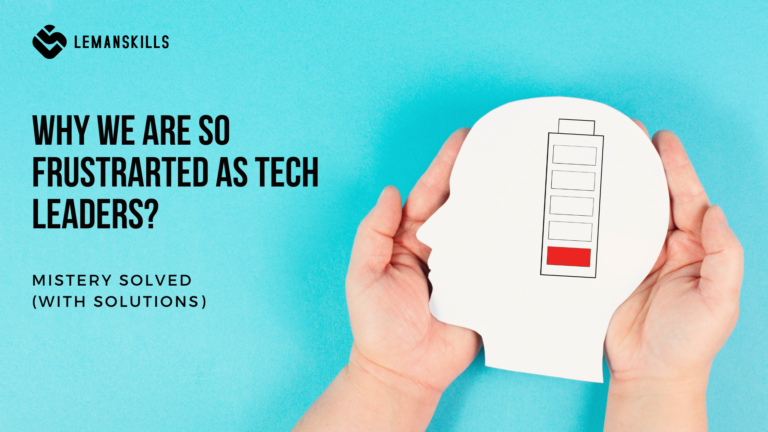
Why Are We So Frustrated as Tech Leaders?

Just think about it for a moment. When was the last time you were angry, pissed off, or frustrated with the other person as a leader? Your direct report didn’t deliver something on time or to the quality that you wanted them to deliver? A person promised to do something, and they didn’t? Or a person asked you a question, you answered, and then they came back with the same question one time, two times, three times, five times? When was the time when you agreed on something? You made a contract on who is doing what:  With the client, a contractor, or a vendor; you delivered your part, and they didn’t? Or they did, but the quality of the work was not so good, and you got angry, you thought a lot of not-so-nice things, and maybe you even behaved in an aggressive way. If you’re nodding right now, you’re in the right place. In this article, I’m going to give you answers on why you get so upset when things like that happen, and what to do to manage it better. Let’s go into it. Why am I reacting like that? Do you know people who, even if something’s going on, are calm? It might seem that they don’t even care when you look at them. They’re all chilled out. And then, it’s you: Frustrated, angry, mad at others. Burning up, losing energy, and being exhausted at the end of the day. Is it your reality? If yes, it means that from a personality perspective, you have a strong Thinker or a Persister floor in your Personality Condo. Maybe a Promoter as well, if you are getting angry with people for being too slow (in your frame of reference, of course). It means that your beliefs about yourself in the world go like this: Thinker: “People need to be competent, deliver work on time, efficiently covering what’s there to be done”. Persister: “People need to be trustworthy, fulfilling the contracts that we have for delivering things, following processes we have in place”. Promoter: “People need to be strong, fast, and self-sufficient. They need to act, instead of talk or analyse all the time”. If we have convictions like that in our brains, and it is our default way of working, every person who’s not doing things like that will make us angry or resentful. It’s mostly unconscious, and until we start learning more about Communication Intelligence (CQ), it’s an automatic thinking pattern we go into in every situation that jeopardises how we think the world should look. Eustress vs Distress The answer to why we’re reacting in an aggressive or manipulative way when we have those thoughts in our brains is that we are in distress. Let’s unpack the stress part, since it’s not very often described in two ways: Eustress and Distress. Eustress is a positive stress. It: mobilizes us to take action; positively influences ourselves and people around us; keeps us in strengthening beliefs, pushes us to do things that bring extraordinary results. Eustress is a feeling of excitement, a little bit of adrenaline rushing through our veins, making us brave to go into the uncomfortable. Like being on the stage, sharing things we are truly passionate about with the thought in our brains that we can really change something while sharing it with the world. But, as always, there’s a dark side to the story. Distress is a negative stress. It: is an automatic sequence of thinking, reacting, and doing things (or not doing them at all); negatively influences ourselves and the people around us; keeps us in limiting beliefs, takes us away from the access to the resources we have in ourselves (intellectual, emotional, cognitive, etc.). We go into distress most of the time right away in two situations: We don’t have our physiological needs covered; We don’t have our motivational / psychological needs covered. So, if you’re hungry, thirsty, you haven’t been in the bathroom for hours, you lack sleep or physical touch of a close person, your body is upset, which makes it distressed. And if your motivational needs connected to your personality Base are not covered, your brain and soul are upset, which makes it distressed. Distress is visible when we are anxious, our heart is beating fast, our blood pressure is high, our voice, hands, and knees are shaking, sometimes we have a sore throat, and we can’t even say a thing. It’s when we forget everything we wanted to say, even if we’re well-prepared and equipped. It’s when we lose the brain-spine connection, and we start to behave extremely weirdly, like we’re not ourselves anymore. That’s where the anger, frustration, and consequently, burnout comes. What can we do about it? The awareness is one thing (super important), but action is crucial. Some things will be transferable for every personality Base, and some will be tailored. Let’s start with the individual ones, connected with the 3 types we’ve talked about above: For Thinkers: Make clear contracts, share tasks and responsibilities transparently, and put deadlines whenever you can. Ask for feedback for your efficient work delivered regularly. Structure your day / week, book slots for deep work in your calendar, and protect your time. For Persisters: Make clear contracts, double-check if people have everything they need (resources, skills, technology, etc.) to work efficiently. Ask for feedback for your principled work regularly. Share your convictions with others and have a conversation when you can gather positive recognition for what you believe in. For Promoters: Make a plan and follow it. Remember that not all people work as fast as you, so give them more time before the deadline is due. Take care of the diversification of what you do, so you don’t get bored too quickly. Plan some adrenaline rushes in your private and/or work life. The things you can do to protect yourself from going into distress that are universal to all personality bases are not fancy. I don’t think
Read More »
Transactional Analysis

Process Communication Model (PCM): Promoter

Can you recall any situation when a person went straight into doing things, sometimes without more in-depth analysis? Maybe too risky in your head? Or maybe it’s a person who is always in the movement, never sits in one place, and you feel like they live 3 lives in 1? That’s The Promoter. The third of six personality types in Process Communication Model. We’ve already covered two of them: Persister and Thinker. Today we go into the next one, filling out the gaps in knowledge so it all makes sense after we cover everything. We’ll have the base on we can stand to start acting on it: not only KNOW from the rational perspective what we should do. Doing and practice: that’s what is the most important for the Promoter in the PCM personality Base. Let’s go into this world today to check what is the whole fuss about. How do we recognize Promoter? Promoter is a person who experience the world through the lens of doing things, acting on them, movement. Their perception is action itself, since they use their delivery part of themselves the most frequently. They always look for excitement and change in what is happening in their life, when they get a task, project or want to decide on something. The things around them need to be different, challenging, new. They don’t want to wait: they want to experience the world here and now. How to recognize a Promoter in the Base of personality? Again, the easiest way to make a strong hypothesis is to look for the key words that the person uses the most. For Promoter it will be: “Let’s go!”, “Let’s do things!?”, “Why to wait: let’s go and do it now!”, “doing…”, “walking the walk…”, “no more talking, let’s do things”. They say all of that because for them what’s important is seeing the results of their actions. They hate to wait, overanalyze, focusing on too many details. What’s important for them is to go, do things, see what happens and calibrate if needed. The recognition of Promoter is also easier when we look on their non-verbal communication: most of the time they have the furrows between the eyebrows (lion’s wrinkle), their voice is rather strong, they talk fast since they don’t want to waste time. Moderate gestures and body language, rather adjusted to the aim they have to achieve. If you see and hear it, that’s a strong indicator that there’s a Promoter in the Base on the other side of the communication process. How to use it to get along with that kind of person? What does Promoter need in communication?   The Promoter needs communication process where they have a chance to go straight to the action. Extremely important for them as well is to know what to do, have space to do it and act as soon as possible. To be efficient in communication with Promoter, we need to use directive channel of communication (quite different than we had in Persister’s and Thinker’s story). Directive channel means that we create a sentence with a dot at the end of it. Promoter doesn’t want to waste time, so asking them questions or small talk is a nonsense, will never work. That means that we need to directly tell them whats’ there to be done. Using the same example that we got in the Persister’s and Thinker’s case: when we want to delegate a task, so a chosen employee covers it, the great approach will be just telling them about it. “Please go and do a task X, the deadline for it is Y”. Honestly: it’s all they need, nothing fancy. They value Autocratic interaction style. It means that they are the most efficient when the other person just tells them what is there to be done and leave them alone, so they can go and focus on the delivery. Straight to the point, sometimes (especially for the people that are not so big fans of a directive communication channel” might look a little harsh or cold. But for them, it’s perfect. Promoter seek to answer the existential question: am I alive? It’s good to feed that question, especially when we see that Promoter is under some kind of stress or pressure. For them the following equation is the only truth. I’m alive = I can deliver value to the world Motivational needs attached to this PCM type is It’s important to know it, since when those needs are not met, Promoter goes into distress and loses access to their skills, abilities to think clearly. Excitement means that Promoter needs to have stimuli, things to do, new projects, environment, tasks to cover. This need can be covered equally good in private as in professional life. But the important thing is that boredom, monotonous tasks or circumstances is the worst thing that can happen to Promoter. When do we know that Promoter is in distress? Just a reminder: distress is negative stress, that costs us (and our environment) something. We are in distress when our motivational needs are frustrated and to cover them (in a really bizarre way), we into the distress sequence. How does is look like for a Promoter? Driver: you need to be strong for me (meaning: you are OK only if you are strong). On this level, Promoter will expect that people will suck it up, that they do everything on their own, without asking for help (which is weakness). When we see that kind of behavior, we can offer more excitement, changing the environment (going for the walk is sometimes enough), give a new task (even if it’s super small and might look stupid). Blamer Mask. Promoter wears a blamer mask on the second level of distress. It their case it means that they start to manipulate others, set up arguments, sometimes create negative drama. Everything to cover their need of excitement since they are bored. And drama is better than boredom. Cellar: At the

Read More »